

















































































































Ayn Rand
Ayn Rand
Initially, Rand struggled in Hollywood and took odd jobs to pay her basic living expenses. While working as an extra on Cecil B. DeMille's King of Kings, she intentionally bumped into an aspiring young actor, Frank O'Connor, who caught her eye. The two married in 1929. In 1931, Rand became a naturalized citizen of the United States. Her first literary success came with the sale of her screenplay Red Pawn in 1932 to Universal Studios. Rand then wrote the play The Night of January 16th in 1934, which was highly successful, and published two novels, We the Living (1936), and Anthem (1938). While We the Living met with mixed reviews in the U.S. and positive reviews in the U.K., Anthem received significiant and positive reviews only in England, due in part to its odd publication history. She was up against The Red Decade in America, and Anthem did not even find a publisher in the United States; it was first published in England. Besides, Rand had still not perfected her literary style and these novels cannot be considered representative.
Without Rand's knowledge or permission, We The Living was made into a pair of films, Noi vivi and Addio, Kira in 1942 by Scalara Films, Rome. They were nearly censored by the Italian government under Benito Mussolini, but they were permitted because the novel upon which they were based was anti-Soviet. The films were successful and the public easily realized that they were as much against Fascism as Communism, and the government banned them quickly thereafter. These films were re-edited into a new version which was approved by Rand and re-released as We the Living in 1986.
Rand's first major professional success came with her best-selling novel The Fountainhead (1943), which she wrote over a period of seven years. The novel was rejected by twelve publishers, who thought it was too intellectual and opposed to the mainstream of American thought. It was finally accepted by the Bobbs-Merrill Company publishing house, thanks mainly to a member of the editorial board, Archibald Ogden, who praised the book in the highest terms and finally prevailed. Eventually, The Fountainhead was a worldwide success, bringing Rand fame and financial security.
The theme of The Fountainhead is "individualism and collectivism in man's soul". It features the lives of five main characters. The hero, Howard Roark, is Rand's ideal, a noble soul par excellence, an architect who is firmly and serenely devoted to his own ideals and believes that no man should copy the style of another in any field, especially architecture. All the other characters in the novel demand that he renounce his values, but Roark maintains his integrity. Unlike traditional heroes who launch into long and passionate monologues about their integrity and the unfairness of the world; Roark, in contrast, does it with a disdainful, almost contemptuous taciturnity and laconicism.
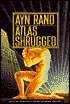
Rand's magnum opus, Atlas Shrugged, was published in 1957, becoming an international bestseller. Atlas Shrugged is often seen as Rand's most complete statement of the Objectivist philosophy in any of her works of fiction. In its appendix, she offered this summary:
"My philosophy, in essence, is the concept of man as a heroic being, with his own happiness as the moral purpose of his life, with productive achievement as his noblest activity, and reason as his only absolute."
The theme of Atlas Shrugged is "The role of man's mind in society". Rand upheld the industrialist as one of the most admirable members of any society and fiercely opposed the popular resentment accorded to industrialists. This led her to envision a novel wherein the industrialists of America go on strike and retreat to a mountainous hideaway. The American economy and its society in general slowly start to collapse. The government responds by increasing the already stifling controls on industrial concerns. The novel, despite its central political theme, deals with issues as complex and divergent as sex, music, medicine, and human ability.
More Info:
http://en.wikipedia.org/wiki/Ayn_Rand
Anthem
Atlas Shrugged
Capitalism
For the New Intellectual
Night Of January 16th
The Fountainhead
2.75 MB
Initially, Rand struggled in Hollywood and took odd jobs to pay her basic living expenses. While working as an extra on Cecil B. DeMille's King of Kings, she intentionally bumped into an aspiring young actor, Frank O'Connor, who caught her eye. The two married in 1929. In 1931, Rand became a naturalized citizen of the United States. Her first literary success came with the sale of her screenplay Red Pawn in 1932 to Universal Studios. Rand then wrote the play The Night of January 16th in 1934, which was highly successful, and published two novels, We the Living (1936), and Anthem (1938). While We the Living met with mixed reviews in the U.S. and positive reviews in the U.K., Anthem received significiant and positive reviews only in England, due in part to its odd publication history. She was up against The Red Decade in America, and Anthem did not even find a publisher in the United States; it was first published in England. Besides, Rand had still not perfected her literary style and these novels cannot be considered representative.
Without Rand's knowledge or permission, We The Living was made into a pair of films, Noi vivi and Addio, Kira in 1942 by Scalara Films, Rome. They were nearly censored by the Italian government under Benito Mussolini, but they were permitted because the novel upon which they were based was anti-Soviet. The films were successful and the public easily realized that they were as much against Fascism as Communism, and the government banned them quickly thereafter. These films were re-edited into a new version which was approved by Rand and re-released as We the Living in 1986.
Rand's first major professional success came with her best-selling novel The Fountainhead (1943), which she wrote over a period of seven years. The novel was rejected by twelve publishers, who thought it was too intellectual and opposed to the mainstream of American thought. It was finally accepted by the Bobbs-Merrill Company publishing house, thanks mainly to a member of the editorial board, Archibald Ogden, who praised the book in the highest terms and finally prevailed. Eventually, The Fountainhead was a worldwide success, bringing Rand fame and financial security.
The theme of The Fountainhead is "individualism and collectivism in man's soul". It features the lives of five main characters. The hero, Howard Roark, is Rand's ideal, a noble soul par excellence, an architect who is firmly and serenely devoted to his own ideals and believes that no man should copy the style of another in any field, especially architecture. All the other characters in the novel demand that he renounce his values, but Roark maintains his integrity. Unlike traditional heroes who launch into long and passionate monologues about their integrity and the unfairness of the world; Roark, in contrast, does it with a disdainful, almost contemptuous taciturnity and laconicism.
Rand's magnum opus, Atlas Shrugged, was published in 1957, becoming an international bestseller. Atlas Shrugged is often seen as Rand's most complete statement of the Objectivist philosophy in any of her works of fiction. In its appendix, she offered this summary:
"My philosophy, in essence, is the concept of man as a heroic being, with his own happiness as the moral purpose of his life, with productive achievement as his noblest activity, and reason as his only absolute."
The theme of Atlas Shrugged is "The role of man's mind in society". Rand upheld the industrialist as one of the most admirable members of any society and fiercely opposed the popular resentment accorded to industrialists. This led her to envision a novel wherein the industrialists of America go on strike and retreat to a mountainous hideaway. The American economy and its society in general slowly start to collapse. The government responds by increasing the already stifling controls on industrial concerns. The novel, despite its central political theme, deals with issues as complex and divergent as sex, music, medicine, and human ability.
More Info:
http://en.wikipedia.org/wiki/Ayn_Rand
Anthem
Atlas Shrugged
Capitalism
For the New Intellectual
Night Of January 16th
The Fountainhead
2.75 MB
posted by Navin Parasrampuria | 12:29 am

1 Comments:
ayn rand interview in playboy mag is not found in rshare. please reupload it. pokamiami@yahoo.com
Post a Comment
<< Home